June 14, 1998.
The Delta Center in Salt Lake City was roaring.

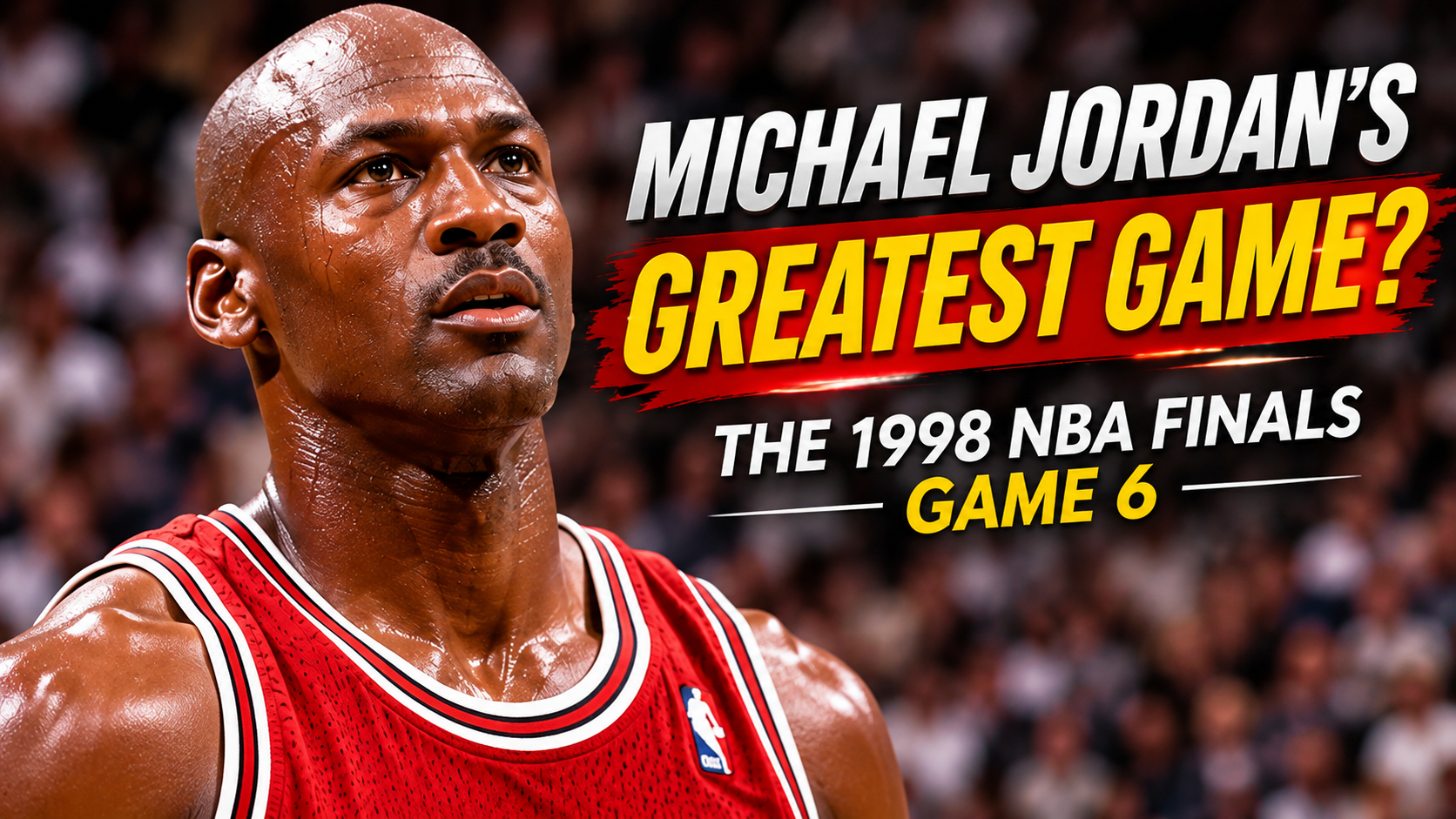
June 14, 1998.
The Delta Center in Salt Lake City was roaring.
The Utah Jazz were seconds away from forcing a Game 7 against the Chicago Bulls.
Michael Jordan was exhausted, Scottie Pippen was struggling with a back injury, and Chicago's legendary dynasty was fighting to survive one final night.
Then Jordan did something extraordinary.
He scored, stole the ball, and delivered one of the most famous shots in basketball history.
In a matter of seconds, the Chicago Bulls transformed a possible defeat into an 87–86 victory.
Jordan finished with 45 points.
The Bulls claimed their sixth NBA championship in eight seasons.
And a single image of Jordan holding his shooting hand in the air became part of basketball history.
Was this Michael Jordan's greatest game ever?
There are other candidates, but few games combined such enormous stakes with such a perfect ending.
The 1998 NBA Finals brought together two of the most formidable teams of the decade.
The Chicago Bulls were seeking their sixth championship.
The Utah Jazz, led by Karl Malone and John Stockton, were determined to win their first.
Chicago entered Game 6 with a 3–2 series lead.
One more victory would secure another title.
A Utah win would force a deciding Game 7 in Salt Lake City.
The Bulls had already survived a demanding season.
Jordan was 35 years old.
Dennis Rodman remained a vital defensive and rebounding presence.
Scottie Pippen was still essential to Chicago's system, but physical problems threatened his effectiveness.
The Jazz had home-court advantage and an opportunity to extend the series.
For Jordan, the stakes could hardly have been higher.
This was more than another playoff game.
It was a chance to complete one of the most remarkable championship runs in American sports.

The Bulls faced a major problem early in the game.
Scottie Pippen was dealing with severe back pain.
His mobility was limited, and he struggled to contribute offensively.
Pippen would finish the game with only eight points.
That placed even greater responsibility on Jordan.
Chicago could not depend on its usual balance of offensive contributions.
Jordan needed to create shots, attack the defense, and keep his team competitive.
The Jazz understood the situation.
Utah had Karl Malone controlling the interior and John Stockton directing the offense.
Every possession became increasingly important.
Jordan responded by taking on an extraordinary offensive workload.
He attempted 35 field goals during the game.
He also repeatedly attacked the basket and earned trips to the free-throw line.
It was not always beautiful basketball.
But it was the kind of demanding performance championship teams sometimes need from their greatest player.
As the game progressed, Utah continued to challenge Chicago.
The Jazz were physical, disciplined, and confident in front of their home crowd.
Jordan carried much of Chicago's scoring burden.
His midrange jumpers kept the Bulls within striking distance.
His drives forced Utah defenders to react.
And his competitive intensity remained unmistakable.
Toni Kukoč provided important support, finishing with 15 points.
But Jordan was the central figure.
By the end of the game, he would account for more than half of Chicago's total points.
That statistic alone tells part of the story.
Jordan was not simply making the final shot.
He was keeping the Bulls alive long enough for that shot to matter.
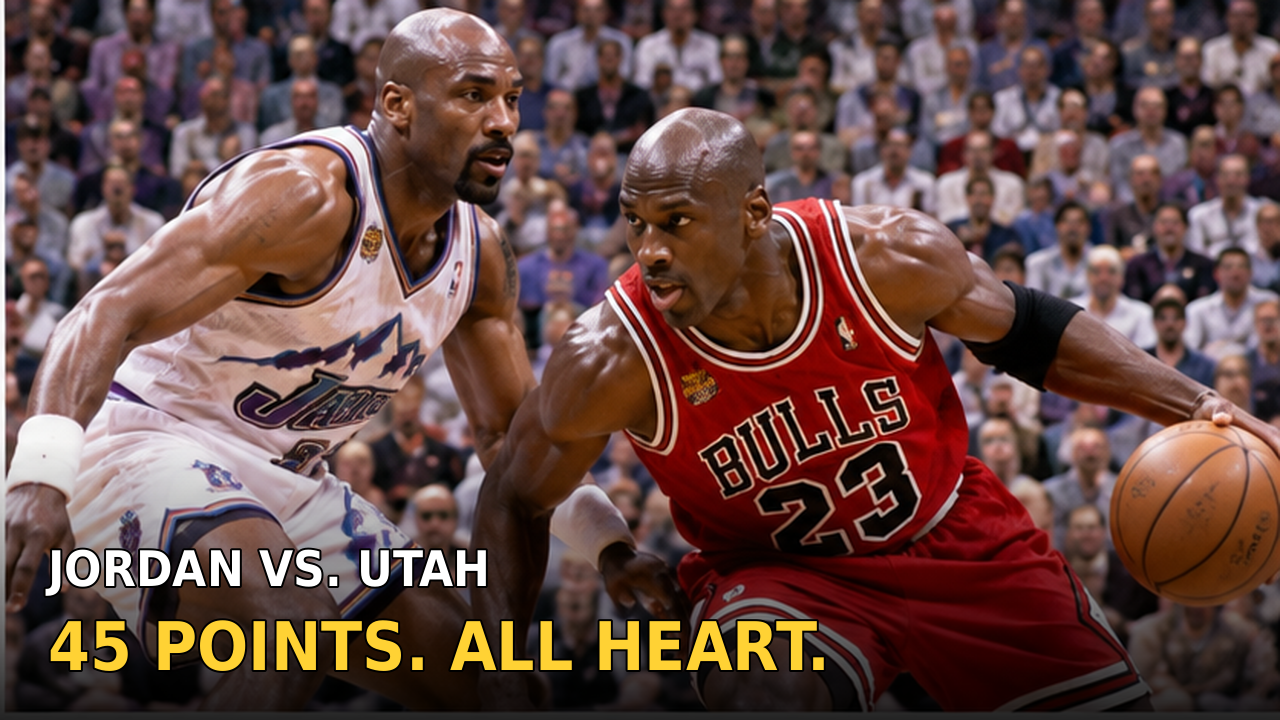
With less than a minute remaining, Utah appeared to have the advantage.
John Stockton made a crucial three-pointer to put the Jazz ahead 86–83.
The home crowd erupted.
Chicago was suddenly in danger of losing Game 6.
Jordan answered by driving to the basket.
His layup reduced the deficit to 86–85 with approximately 37 seconds remaining.
Now the Bulls needed a defensive stop.
Utah had the ball.
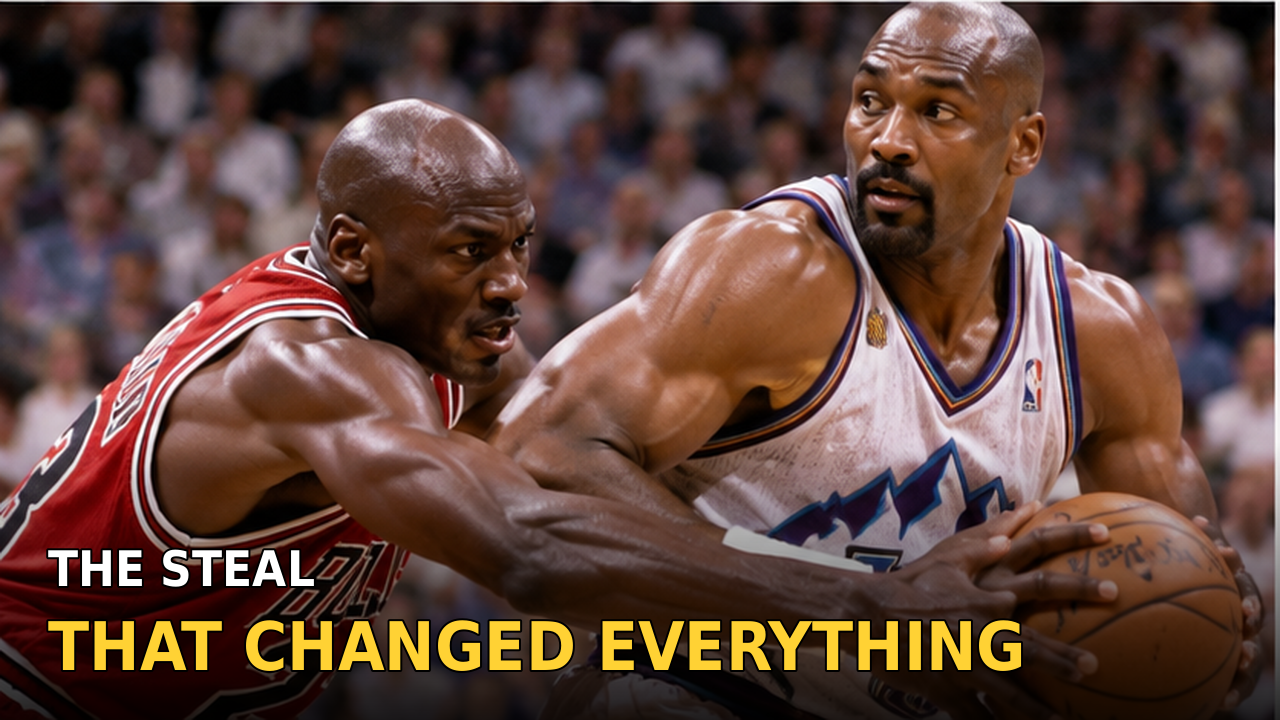
Karl Malone received it in the low post.
A successful Jazz possession could have placed Chicago in an extremely difficult position.
Jordan recognized the opportunity.
He moved toward Malone from behind.
Then he knocked the ball away.
The steal changed everything.
Chicago had possession.
The Bulls were down by one.
And Michael Jordan had another chance to decide the championship.
The final jumper receives most of the attention.
But Jordan's steal against Karl Malone was just as important to the outcome.
Without that defensive play, Chicago might never have had the opportunity to take the lead.
The sequence showed why Jordan was more than an extraordinary scorer.
He was also a dangerous defender with excellent timing.
As Malone controlled the ball in the post, Jordan approached and stripped it away.
There was no immediate need for a timeout.
Jordan brought the ball up the floor.
He understood the situation.
Chicago trailed by one point.
The championship was within reach.
And the final possession would almost certainly belong to him.
Jordan crossed into the offensive half of the court.
Bryon Russell stepped forward to defend him.
The Jazz knew who would take the shot.
Everyone in the arena knew.
Jordan dribbled toward his right.
Russell moved with him.
Then Jordan changed direction, creating separation as Russell lost his balance.
Jordan rose for a jumper near the free-throw line area.
The ball left his hands.
For a brief moment, the entire championship seemed suspended in the air.
Then the shot went in.
Chicago led 87–86.
Only 5.2 seconds remained.
Jordan held his follow-through as the ball dropped through the net.
The image became one of the defining photographs of his career.
The Jazz still had a final opportunity.
But John Stockton missed a three-point attempt.
The buzzer sounded.
The Chicago Bulls were NBA champions again.
The shot remains famous for another reason.
Basketball fans have debated Jordan's contact with Bryon Russell for decades.
As Jordan changed direction, his left hand made contact with Russell.
Some viewers believe Jordan pushed the defender away.
Others argue that Russell's momentum and Jordan's sudden movement created the separation.
No offensive foul was called.
The basket counted.
Chicago won the championship.
The controversy has become part of the play's history.
But focusing only on the possible push-off misses the larger sequence.
Jordan had already scored a crucial layup.
He had stolen the ball from Malone.
And he had created an opportunity to win the championship with one final shot.
Regardless of how fans interpret the contact, the moment remains among the most discussed plays in NBA history.
Jordan's final statistics demonstrated the scale of his performance.
| Statistic | Michael Jordan |
|---|---|
| Points | 45 |
| Field goals | 15 of 35 |
| Three-pointers | 3 of 7 |
| Free throws | 12 of 15 |
| Steals | 4 |
| Minutes played | Approximately 44 |
Chicago scored 87 points as a team.
Jordan scored 45 of them.
He also scored the Bulls' final eight points.
The numbers are extraordinary.
But statistics alone cannot fully capture the pressure of the final minute.
The Bulls needed a basket.
Jordan delivered.
They needed a defensive stop.
Jordan delivered again.
Then they needed one more basket.
And Jordan delivered the most famous shot of the night.
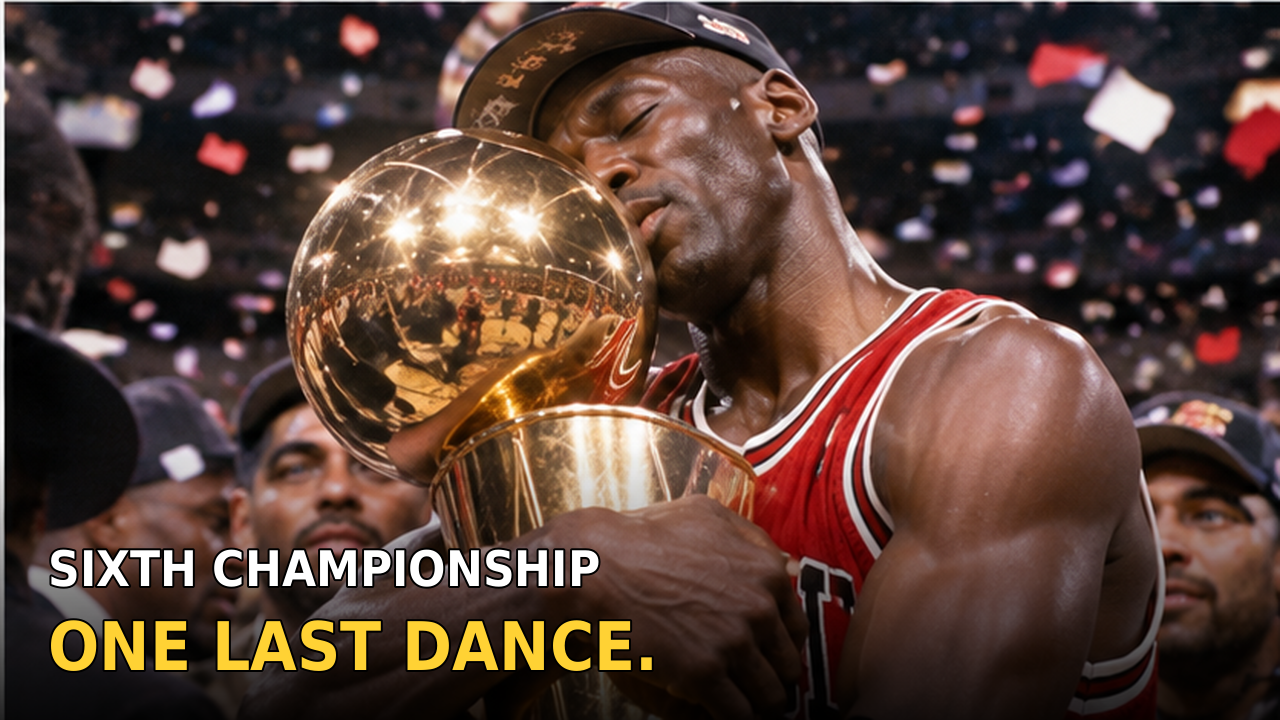
The victory gave Chicago its sixth NBA championship in eight seasons.
It also completed the Bulls' second three-peat.
Their first three consecutive championships came in 1991, 1992, and 1993.
Their second run came in 1996, 1997, and 1998.
Jordan earned his sixth NBA Finals MVP award.
He had won the championship in all six of his NBA Finals appearances.
For Chicago fans, the achievement represented the culmination of an extraordinary era.
The team had become one of the most recognizable sports dynasties in the world.
But the celebration also carried uncertainty.
Phil Jackson's future with the organization was in doubt.
The roster was approaching major changes.
Jordan would retire for the second time in January 1999.
Although he later returned to the NBA with the Washington Wizards, the 1998 Finals marked his last game in a Chicago Bulls uniform.
And that famous jumper was the final shot of his Bulls career.
Jordan produced several performances that deserve consideration.
His 63-point playoff game against the Boston Celtics in 1986 demonstrated his extraordinary scoring ability.
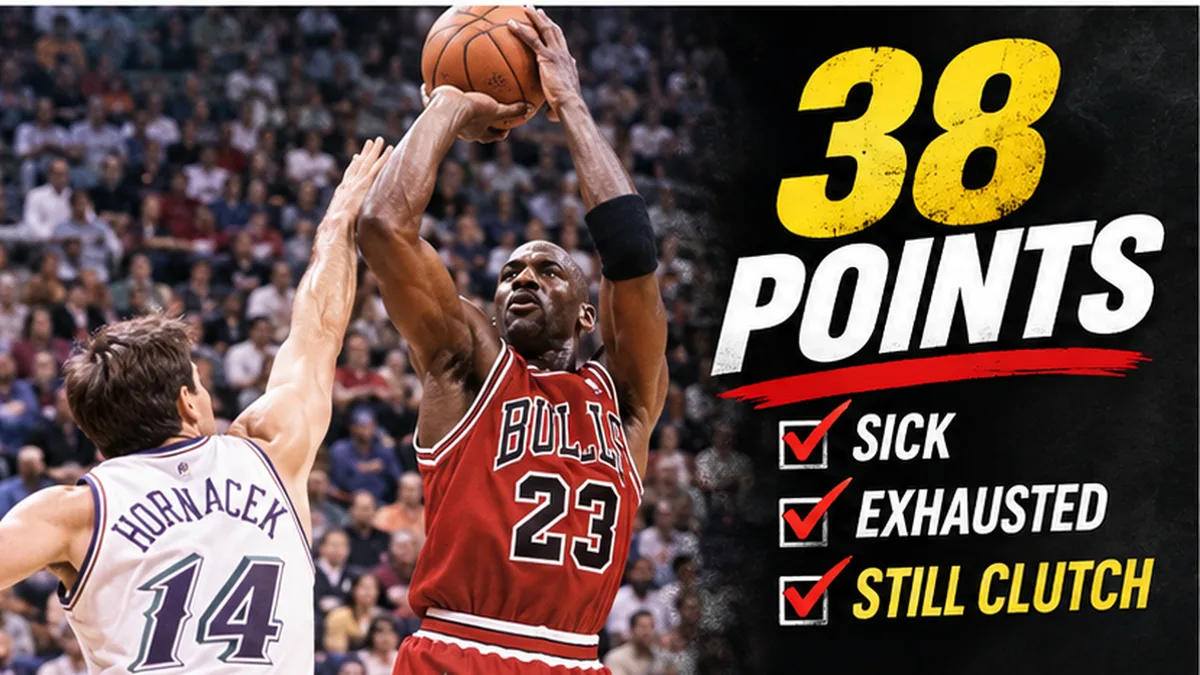
His 1997 NBA Finals Game 5 performance against Utah, often called the Flu Game, became legendary because he played through serious illness.
And his 1992 Finals performance against Portland included the famous shrug after a remarkable first-half shooting display.
Each game revealed a different aspect of his greatness.
But Game 6 in 1998 combined almost everything.
The championship was on the line.
His most important teammate was physically limited.
His team needed him to carry the offense.
He scored 45 points.
He made the decisive defensive play.
And he hit the game-winning jumper.
It is difficult to imagine a more complete dramatic ending.
The final sequence has been replayed countless times.
It appears in documentaries, highlight reels, basketball discussions, and retrospectives of the 1990s.
For fans who watched the game live, it remains a powerful memory.
For younger audiences, it offers a glimpse of the intensity surrounding Jordan's final championship with Chicago.
The moment also illustrates why basketball history cannot be reduced to statistics.
A great performance is partly about timing.
A great shot is partly about circumstance.
And a legendary career is often remembered through a handful of unforgettable images.
Jordan's final shot against Utah brought all three together.
Watch the closing sequence of the 1998 NBA Finals Game 6 through the NBA's official YouTube channel.
MJ's Last Shot — Game 6 of the 1998 NBA Finals
For a longer look at the contest, a full-game recording is also available on YouTube from an independent basketball archive.
Full Game: The Last Shot — Bulls vs. Jazz, June 14, 1998
The official NBA highlight is the recommended video to embed in this article.
Michael Jordan did not win the 1998 championship with one shot alone.
He won it through a remarkable combination of scoring, defensive awareness, determination, and execution under pressure.
But that final jumper provided the perfect image for everything he had accomplished in Chicago.
Six championships.
Six Finals MVP awards.
Two three-peats.
And one unforgettable final shot.
For many basketball fans, Game 6 of the 1998 NBA Finals remains the greatest game of Michael Jordan's career.
Do you agree, or was Jordan's Flu Game in 1997 even more impressive?
Share your favorite Michael Jordan performance in the comments.

COMMENTS (0)
No comments yet.