MAY 25, 1977 — A SPACE ADVENTURE OPENED IN A RELATIVELY SMALL NUMBER OF AMERICAN MOVIE THEATERS AND BEGAN ONE OF THE MOST REMARKABLE SUCCESS STORIES IN CINEMA HISTORY.
The movie was Star Wars.
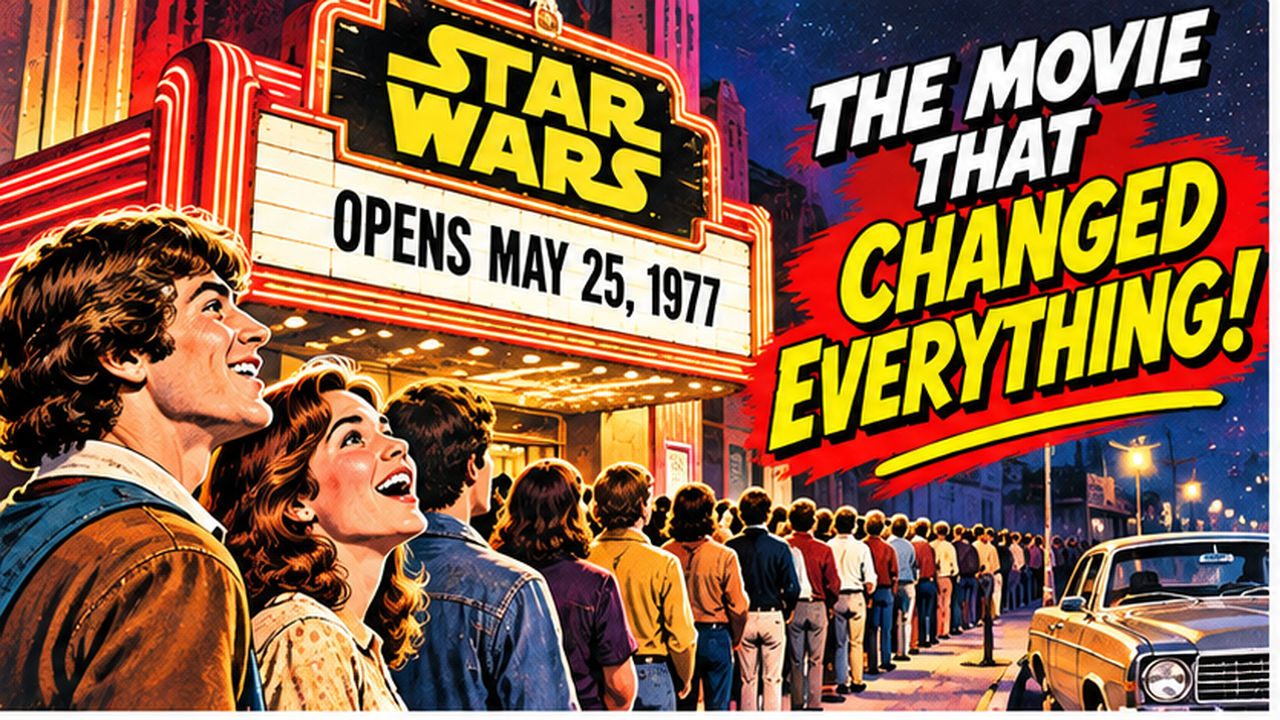
MAY 25, 1977 — A SPACE ADVENTURE OPENED IN A RELATIVELY SMALL NUMBER OF AMERICAN MOVIE THEATERS AND BEGAN ONE OF THE MOST REMARKABLE SUCCESS STORIES IN CINEMA HISTORY.
The movie was Star Wars.
Its creator was George Lucas, a filmmaker with an ambitious vision of distant planets, space battles, mysterious powers, and unforgettable heroes.
Audiences were introduced to Luke Skywalker, Princess Leia, Han Solo, Darth Vader, and two unusually expressive robots.
What happened next went far beyond a successful theatrical release.
Moviegoers returned for repeat screenings.
Long lines became part of the experience.
Toys, comics, soundtracks, and other merchandise helped turn the film into a cultural phenomenon.
And Hollywood discovered just how powerful a fantasy adventure could become when storytelling, technology, music, and marketing worked together.
But Star Wars did not begin as an obvious blockbuster.
Its journey to the screen was difficult, its technical demands were enormous, and its eventual success exceeded expectations.
Here is the true story of how a film released in 1977 helped reshape modern entertainment.
HOLLYWOOD — EARLY 1970s.
American cinema was experiencing a period of creative experimentation.
Filmmakers were exploring complicated characters, social tensions, crime, politics, and darker themes.
Movies such as The Godfather, Taxi Driver, and Chinatown demonstrated the popularity of ambitious, adult-oriented storytelling.
Meanwhile, science fiction had produced important films, including Stanley Kubrick's 2001: A Space Odyssey.
But the type of adventure Lucas imagined was different.
He wanted to combine the excitement of old movie serials with mythology, fantasy, action, and futuristic technology.
His story would feature heroic rebels battling an authoritarian empire.
Instead of presenting the future as cold and clinical, Lucas imagined a universe that looked lived-in.
Spaceships were scratched and dirty.
Machines sometimes malfunctioned.
Characters argued, joked, and made mistakes.
The result was a world that felt fantastical yet surprisingly tangible.
The challenge was bringing that world to the screen.
George Lucas had already established himself as a promising director through American Graffiti, released in 1973.
That film's success helped him pursue a very different project.
Star Wars would require elaborate sets, unusual costumes, complex spacecraft sequences, and visual effects that existing filmmaking methods could not easily deliver.
Lucas wrote and revised the screenplay while working to secure studio support.
Twentieth Century-Fox eventually backed the project.
Principal photography began in 1976.
The production involved location filming in Tunisia and studio work in England.
The desert landscapes helped create the world of Tatooine, Luke Skywalker's home planet.
But building the film's imaginary universe was expensive and technically demanding.
Sets, creatures, models, costumes, and effects all needed to fit together.
The film's production budget ultimately reached approximately $11 million.
That was a substantial investment, although modest compared with the enormous blockbuster budgets that became common decades later.
Lucas was attempting something unusually ambitious for its time.
And many of the tools he needed had to be developed along the way.
WEDNESDAY, MAY 25, 1977 — UNITED STATES.
The original film opened under the title Star Wars.
It was not yet presented to audiences as Episode IV – A New Hope.
That subtitle would be added to the opening crawl in a later theatrical release.
The initial theatrical rollout was limited by modern blockbuster standards.
Contemporary records describe a small opening footprint, although historical accounts differ in how they count the earliest theaters and additional Memorial Day weekend screens.
The American Film Institute catalog records 43 theaters in 31 cities for the initial domestic release.
Other historical accounts identify 32 theaters on opening day, with additional locations joining during the holiday weekend.
Either way, the launch was far smaller than the nationwide releases audiences now associate with major franchise films.
But moviegoers responded.
Theaters began reporting strong ticket sales.
As enthusiasm spread, more people wanted to experience the adventure for themselves.
The phenomenon was growing.
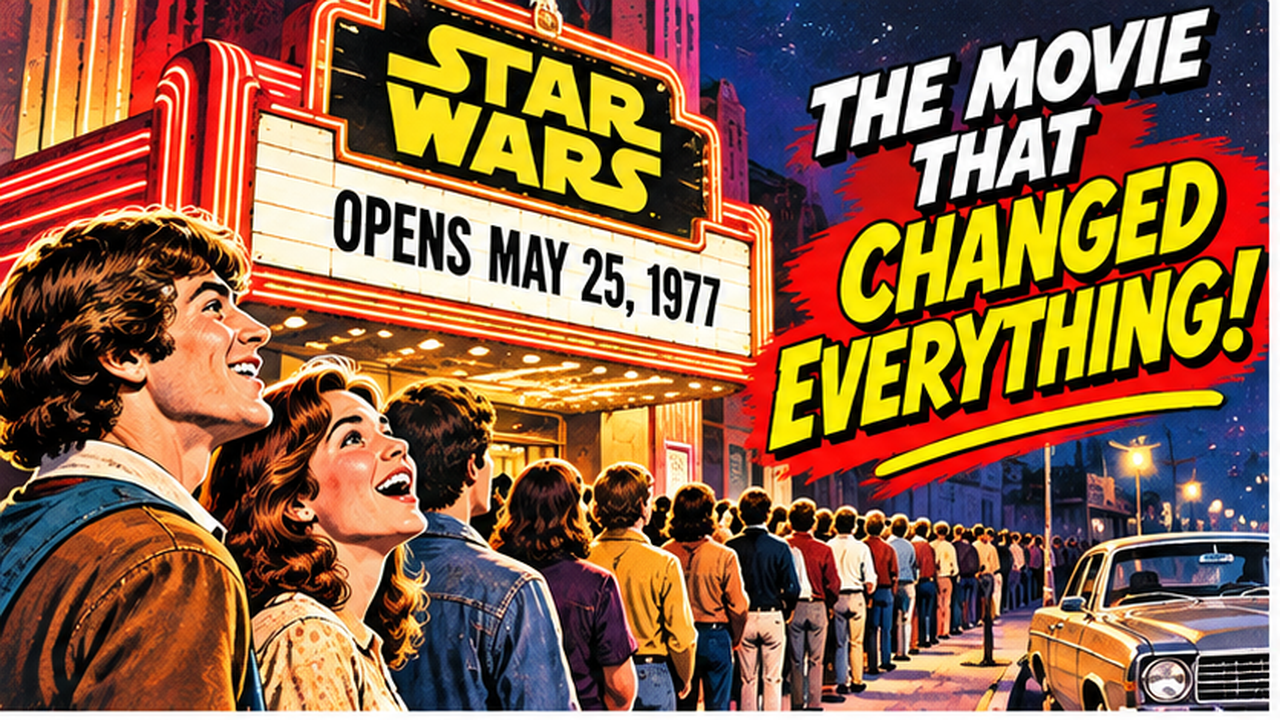
Caption: Star Wars opened in American theaters on May 25, 1977, before expanding into a major box-office phenomenon.
One of the film's most memorable moments occurs almost immediately.
After the opening crawl, a spacecraft moves across the screen.
Then an enormous Imperial Star Destroyer appears above it.
The vessel seems to stretch across the image, emphasizing the immense scale of the pursuing warship.
For audiences in 1977, the sequence was an extraordinary demonstration of cinematic spectacle.
It immediately established the imbalance between the small rebel spacecraft and the overwhelming military power of the Empire.
It also showed how visual storytelling could communicate information before the characters explained anything.
The sequence did not depend on a lengthy introduction.
The images themselves established danger, scale, and conflict.
That approach became one of the defining strengths of the film.
Lucas trusted audiences to enter a fictional universe already in motion.
They did not need to understand every planet, political institution, or technological detail.
They simply needed to follow the adventure.
The visual effects were central to the film's success.
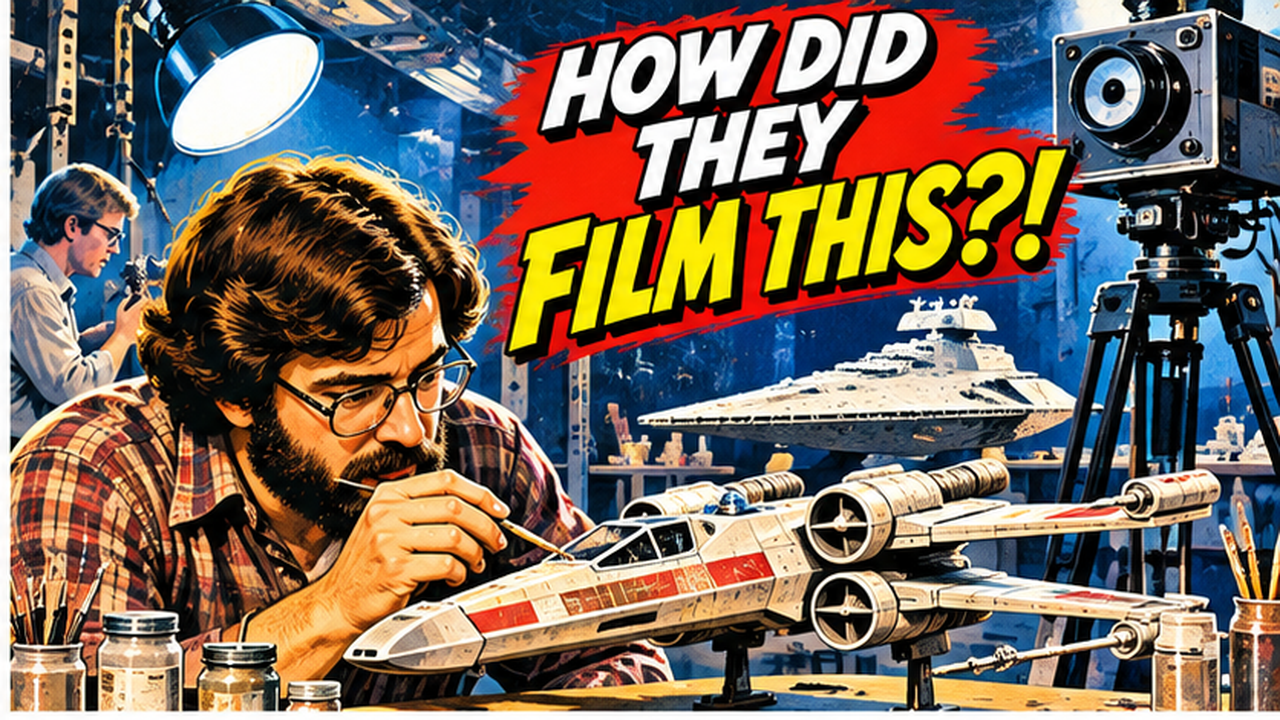
Lucas established Industrial Light & Magic, commonly known as ILM, to help create the imagery required for Star Wars.
The team developed and refined techniques for photographing miniature spacecraft and combining different visual elements into convincing scenes.
Motion-control camera systems helped filmmakers repeat precise camera movements when photographing models.
That capability was especially valuable for complicated space battles involving multiple ships.
The production also used practical models, matte paintings, optical compositing, and other established techniques in ambitious new combinations.
These effects were not computer-generated in the modern sense.
They required physical craftsmanship, careful photography, and extensive technical problem-solving.
The resulting sequences made imaginary spacecraft appear to move through vast environments.
For many viewers, the effects created an unusually convincing sense of speed and scale.
ILM would go on to become one of the most influential visual-effects companies in cinema.
But its origins were tied to a specific problem.
George Lucas needed a way to film the universe he had imagined.
Visual effects were only part of the experience.
The music played an equally important role.
Composer John Williams created an orchestral score that emphasized adventure, mystery, danger, and emotion.
At a time when electronic sounds were often associated with science-fiction films, Lucas chose a sweeping symphonic approach.
Williams used recurring musical themes to help audiences connect with characters and ideas.
The main title immediately established the film's grand, adventurous tone.
Other themes reinforced the emotional and dramatic moments throughout the story.
The score gave the imaginary galaxy a sense of mythic importance.
It also helped connect the film to the traditions of classic Hollywood adventure cinema.
Williams won the Academy Award for Original Score for Star Wars at the 1978 ceremony.
The music became one of the film's most enduring achievements.
Decades later, the opening notes of its main theme remain instantly recognizable to many moviegoers.
The film's popularity grew through a combination of publicity, audience enthusiasm, and word of mouth.
Moviegoers were not simply watching a new release.
They were experiencing an adventure that many wanted to see again.
The characters offered recognizable personalities and relationships.
Luke Skywalker was a young dreamer searching for purpose.
Princess Leia was determined, courageous, and central to the rebellion.
Han Solo brought humor and skepticism.
Darth Vader provided an intimidating antagonist.
R2-D2 and C-3PO contributed personality and comedy.
The story combined familiar themes of friendship, sacrifice, and heroism with a distinctive science-fiction setting.
That combination helped the film appeal to audiences beyond traditional science-fiction enthusiasts.
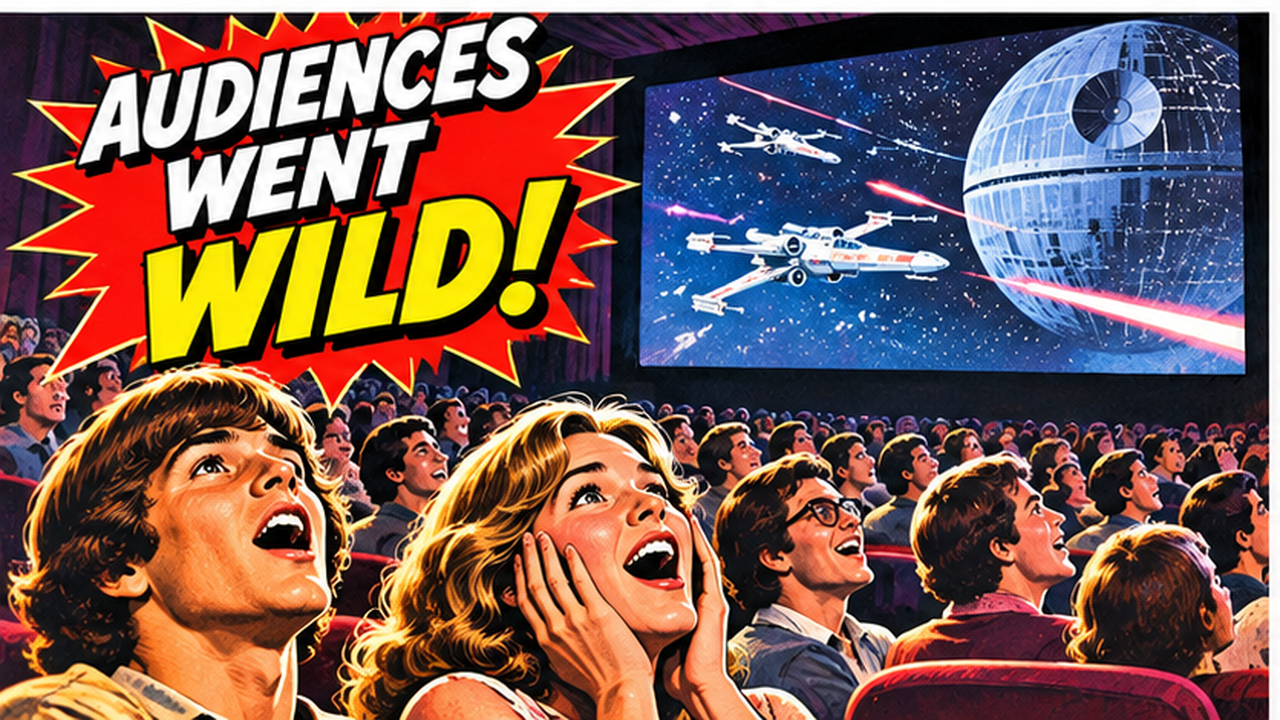
As reports of its success spread, theatrical demand increased.
The queues outside cinemas became part of the film's public image.
The audience response helped transform Star Wars from a promising release into a national entertainment event.
The film's commercial performance exceeded its initial scale.
As its theatrical run expanded, Star Wars became one of the biggest box-office successes in movie history.
Its earnings eventually reached hundreds of millions of dollars.
Historical totals vary depending on whether figures include later theatrical re-releases and international markets.
The broader point is clear.
The original film achieved extraordinary commercial success relative to its production budget.
It demonstrated that an imaginative adventure could attract enormous mainstream audiences.
But the blockbuster era did not begin with Star Wars alone.
Steven Spielberg's Jaws, released in 1975, had already helped establish the commercial power of large-scale summer movie releases.
Star Wars built on that changing industry environment.
Its success further encouraged studios to invest in event movies with broad audience appeal.
It also showed that a film's commercial life could extend far beyond its initial ticket sales.
Star Wars quickly became more than a movie.
Fans wanted to bring parts of its fictional universe into everyday life.
Toys, books, comics, posters, clothing, and collectibles helped extend the experience beyond the theater.
The popularity of action figures became especially important to the franchise's long-term commercial identity.
Children could recreate adventures involving their favorite characters.
Collectors could build collections of vehicles, figures, and memorabilia.
The film also encouraged fans to discuss its fictional history, imagine new stories, and participate in an expanding community.
Movie merchandise existed before Star Wars.
The film did not invent licensed entertainment products.
But its success helped demonstrate how powerful an interconnected movie-and-merchandise business could become.
Over time, the franchise expanded into sequels, television productions, games, novels, and many other forms of entertainment.
The original 1977 release established the foundation for that expansion.
The film's technical achievements received major recognition.
At the 50th Academy Awards in 1978, Star Wars won six competitive Academy Awards.
Its winning categories included Art Direction, Costume Design, Film Editing, Original Score, Sound, and Visual Effects.
Ben Burtt also received a Special Achievement Award for the film's sound effects.
Together, these honors are frequently described as seven Academy Awards, although the distinction between six competitive wins and the special award is worth preserving.
The film was also nominated for Best Picture and Best Director.
It did not win Best Picture.
That award went to Woody Allen's Annie Hall.
Nevertheless, the recognition demonstrated that the film's accomplishments extended beyond ticket sales.
Its craftsmanship had helped establish new expectations for what large-scale fantasy cinema could achieve.
The long-term influence of Star Wars can be seen across several parts of the entertainment industry.
Its success strengthened the appeal of high-concept event movies.
It demonstrated the commercial possibilities of combining films with licensed products.
It helped establish visual effects as an increasingly important part of major studio filmmaking.
And it showed that an original fictional universe could support multiple stories across different media.
The first sequel, The Empire Strikes Back, arrived in 1980.
Return of the Jedi followed in 1983.
Later decades brought prequels, sequels, animated series, live-action television, novels, games, and other projects.
Not every development in modern Hollywood can be attributed to one movie.
The industry's transformation involved many filmmakers, technological advances, and business decisions.
But Star Wars became one of the most influential examples of the possibilities available to blockbuster filmmaking.
Its impact was artistic, technological, and commercial.
ONE MOVIE. ONE GALAXY. A CULTURAL PHENOMENON THAT BEGAN IN 1977.
The original theatrical trailer offers a fascinating look at how Star Wars was introduced to moviegoers.
Its presentation reflects a very different era of movie advertising.
The trailer emphasizes the unusual setting, action, and spectacle that made the film stand out.
Watching it today provides a reminder that audiences in 1977 did not yet know what the franchise would become.
There were no decades of sequels to look back on.
No established cinematic universe stretching across generations.
Just a new space adventure arriving in theaters.
On May 25, 1977, Star Wars arrived in American theaters.
Its opening release was comparatively limited.
Its effects were technically demanding.
And its creator was trying to tell a kind of story that did not fit neatly into the dominant trends of the period.
Yet audiences embraced it.
The film combined an accessible adventure with memorable characters, innovative effects, and an extraordinary musical score.
Its success influenced Hollywood's approach to blockbuster filmmaking and entertainment franchises.
It also created a fictional universe that would continue reaching new generations.
Nearly fifty years later, the original film remains a defining moment in movie history.
And it all began with a space adventure that invited audiences into a galaxy far, far away.
If you could experience one movie premiere from 1977, would you choose Star Wars — or another classic from that year?
And which moment from the original film would you most want to see on the big screen for the first time?
Share your answer in the comments.


COMMENTS (0)
No comments yet.